
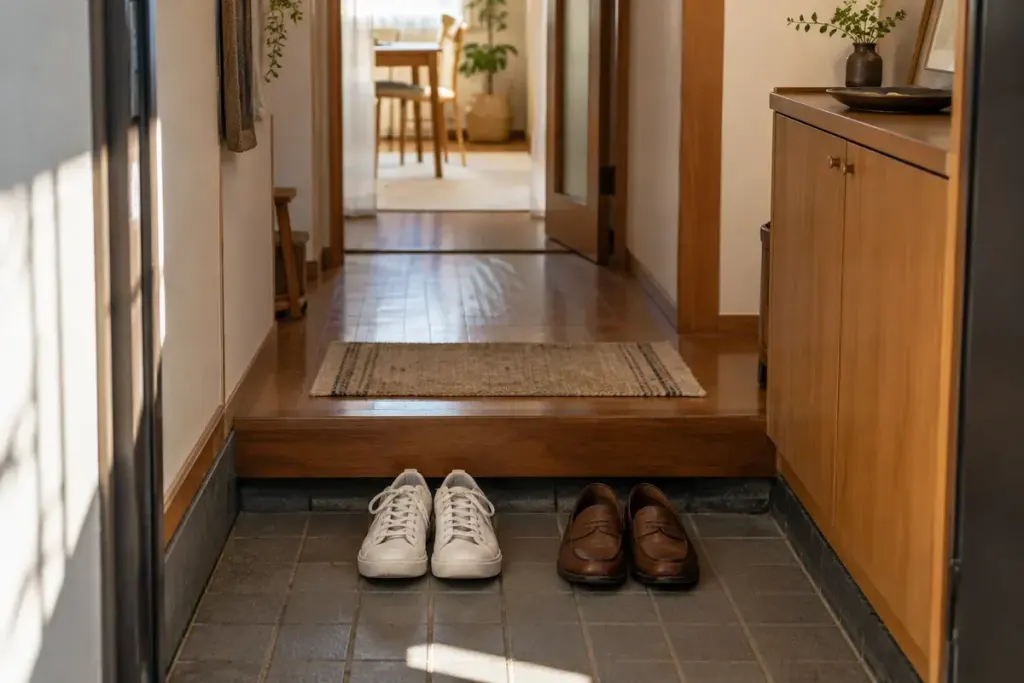
Web Japan describes the genkan as the place to put on and remove shoes. A Japanese apartment’s entrance may include a lower area for removing outdoor shoes before stepping onto the interior floor. This genkan is a practical transition, and its usefulness depends on more than how many shoes fit in a photograph.
Try the arrival with your hands occupied
At an authorised viewing, notice where you could pause with a bag and remove shoes without blocking the door. Check the step, lighting and available support appropriate to your needs. Do not assume that every entrance has the same dimensions or that a small change in level is easy for every resident.
Look at any shoe storage with the door open. A cabinet can occupy little floor space when closed and still interrupt the entrance when used. Keep building rules and the landlord’s instructions in mind before planning added furniture or alterations.
Give wet shoes a workable route
Think about a rainy arrival, visitors and the shoes used most often. Choose a permitted arrangement that keeps the walking route clear and allows the area to be cleaned. Avoid moving overflow into a shared corridor without checking the building’s rules.
For a viewing note, record the transition level, door movement and storage arrangement separately. A genkan is not merely a decorative square on a floor plan: it is a sequence of actions that repeats whenever someone enters or leaves. Testing that sequence can reveal whether an otherwise attractive apartment suits your daily routine.
AI-generated editorial illustration; not a documentary photograph.